A simmering cultural clash within hip-hop has exploded into a public and deeply personal war of words, pitting Atlanta’s 21 Savage against New York’s Fivio Foreign in a confrontation that cuts to the core of authenticity, survival, and generational trauma. The conflict, ignited on the DJ Akademiks podcast, has escalated rapidly, with 21 Savage delivering a scathing, multi-minute rebuttal that questions his rival’s credibility, age, and motives.
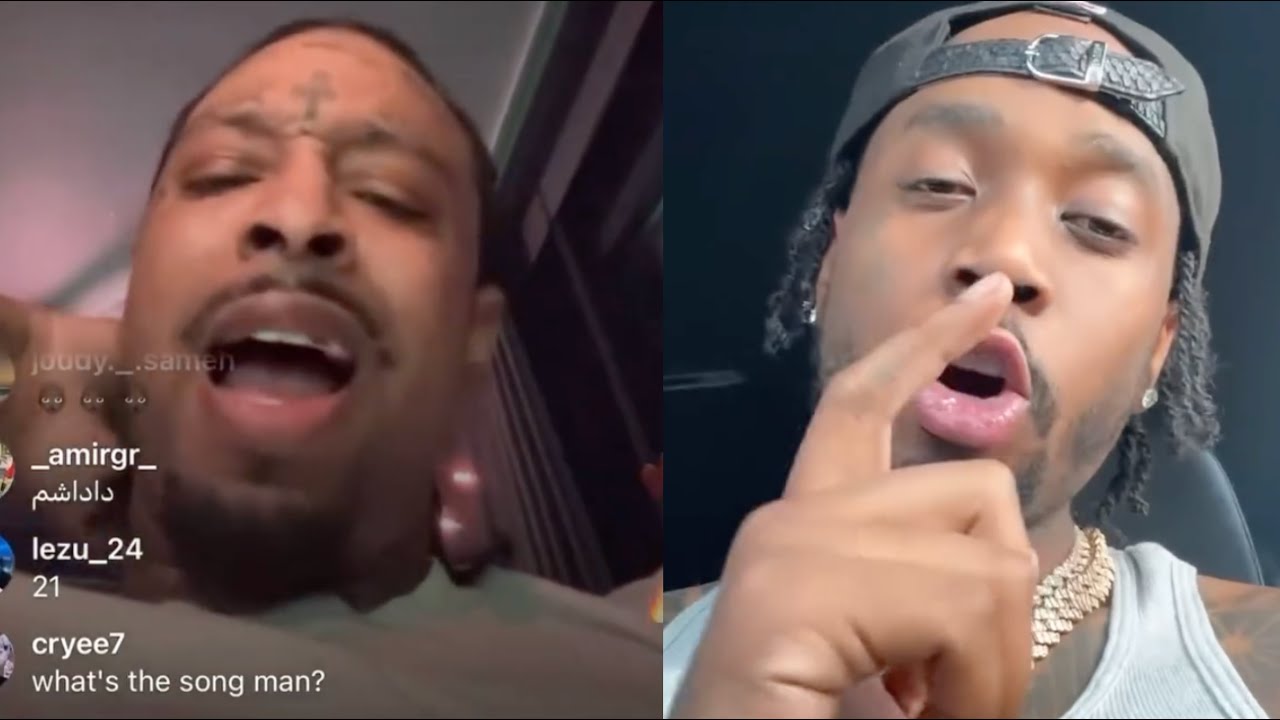 The foundation of the dispute is 21 Savage’s recent public stance advocating for moving beyond street life, a philosophy he frames as “F*k the streets.” He has consistently clarified this is a critique of a destructive mindset, not the people from those environments, emphasizing the streets “don’t love you back.” This perspective, born from his own well-documented past, advocates for financial elevation and escape as the ultimate form of survival.
This message, however, landed with a thud in certain circles, particularly within the New York drill scene where street credentials are often viewed as sacrosanct. The spark flew when Fivio Foreign, a flagship figure of that scene, appeared on Akademiks’ show and was asked about 21’s stance. Fivio immediately questioned 21 Savage’s foundational background, suggesting his reputation was more about musical stature than lived experience.
“He’s just…bro, stop it. Street where?” Fivio said, dismissing the idea. He doubled down, framing 21 Savage as a “rapper-rapper” and contrasting him with New York artists who, in his view, live the life they narrate. Fivio’s critique hinged on a localized definition of credibility, implying one’s “street” status doesn’t translate geographically. He further provoked by referencing how Tekashi 6ix9ine dissed 21 Savage without apparent consequence, a pointed jab at perceived power and respect.
 “You can only be street where you from,” Fivio argued, a statement that immediately drew pushback from Akademiks but set the stage for the confrontation. The implication was clear: 21 Savage, now a wealthy superstar, was philosophically distancing himself from the very conditions that birthed his career, a move Fivio framed as inauthentic or even disrespectful to those still entrenched in that reality.
The response from 21 Savage was not a press statement or a cautious tweet. It was a raw, unfiltered, and devastating video monologue directed squarely at Fivio Foreign. Speaking with a calm yet venomous delivery, 21 Savage systematically dismantled the critique. He commanded Fivio to stop using his name for clout, labeling him “old as hell” and “broke.”
21 Savage’s retort was a masterclass in targeted rhetoric. He inverted the credibility argument, mocking Fivio for being an older rapper who has “been trying to rap since you was goddamn 17, 16, 15.” He challenged the physicality of Fivio’s stance, stating, “If your ass walking around with a .38, don’t say nothing to me about the street.” The core of his fury was the accusation that those who haven’t endured profound loss have no right to critique his hard-won perspective.

“Y’all ain’t cried enough. Y’all ain’t lost enough. Straight up,” he stated, drawing a line between those who have suffered trauma and those he perceives as merely performing a street aesthetic. He accused Fivio of being “washed up” and chasing streams by invoking his name. Crucially, 21 Savage framed his “F the streets” message not as a rejection of his past, but as a mission born from it.
“I’m trying to save the streets. I’m trying to stop all this crazy st that be going on,” he asserted, positioning himself as a reformer, not a traitor. He concluded with a stark warning: his positive messaging should not be mistaken for weakness. “Do not think this st is sweet,” he declared, leaving no ambiguity about his capacity to defend himself.
 The fallout has ripped across social media, exposing a fundamental rift in hip-hop’s relationship with street narratives. One faction champions 21 Savage’s evolutionary stance, applauding his use of platform to advocate for financial and emotional liberation from cycles of violence. They see his message as a necessary, mature progression for a genre often mired in glorification.
The other faction sympathizes with Fivio Foreign’s perspective, viewing the streets as an inescapable source of identity and truth. From this angle, 21’s rhetoric can be seen as dismissive of ongoing struggles and a privileged disavowal of roots. The debate has become a proxy for larger conversations about authenticity, class mobility, and who holds the right to narrate the Black urban experience.
This is more than a simple rap beef; it is a collision of ideologies. It is Atlanta’s focus on entrepreneurial ascent versus New York drill’s gritty, localized realism. It is the voice of experience advocating for escape versus the voice of current struggle defending its dignity. It is a billionaire-minded artist challenging the very system that created him, facing off against an artist for whom that system remains a daily, defining reality.
As of now, the conflict resides in the realm of social media and podcast discourse. There are no diss tracks, no physical altercations reported. Yet, the intensity of the verbal exchange and the deep-seated cultural tensions it reveals suggest this may not be the final chapter. The hip-hop community now watches and waits, parsing every word, knowing that when egos, identity, and principle clash this publicly, the next move is rarely silence. The question hanging in the air is whether this philosophical debate remains just that, or if the pressure will force it into the studio, resulting in the kind of musical confrontation that forever etches such rivalries into the genre’s history.